Enjoy free shipping on local orders over R1500

Our Blog

Explore the rare CSARITE colour changing gemstone

Join Jackie on her Turkish adventure and exploration of the CSARITE mine This mine is home of the CSARITE gemstone, a gemstone which changes colour depending on the light source it is exposed to. Jackie Hahn, owner and lead designer of Penchant Fine Jewellery, has been invited to visit the mine in Turkey at one of the coastal towns called Bodrum. https://penchantdesign.com/ A photo collage of some Jackie’s adventures in Turkey. Where and what is the CSARITE mine Location, a single site, single mine gem in the rural countryside of the Mugla province of South West Turkey, roughly 25km from the small city of Milas, lies the only mine currently known to produce CSARITE®. Located in the westernmost part of the infamous Menderes Massif, the mine is positioned in one of the most continuously deforming areas of the world. At the peaks of the Ilbir mountains lies the world’s only CSARITE® mine more than 3000ft above sea level This, alongside its remote location continues to test modern engineering and technology. It is only because of perseverance and ceaseless cooperation with local communities that Milenyum continues to successfully extract this magnificent gemstone from the Turkish landscape. A New Gemstone for a New Generation Why is the CSARITE® so unique Found in only one place in the world, in a single mine in the rural Turkish mountains of the ancient region of Anatolia, CSARITE® is amongst the world’s rarest and most exquisite gemstones. With a rare and natural ability to shift colours under different light sources, CSARITE® ceaselessly transforms by day and night, indoors and out. Exhibiting a spectrum of natural colours from earthy pistachio and olive greens to golden campaign yellows, deep sunset gingers, and soft pinks and reds, CSARITE® is dynamic and expressive. Join us on this adventurous journey. We will be sharing stories and pics throughout.

Read More »

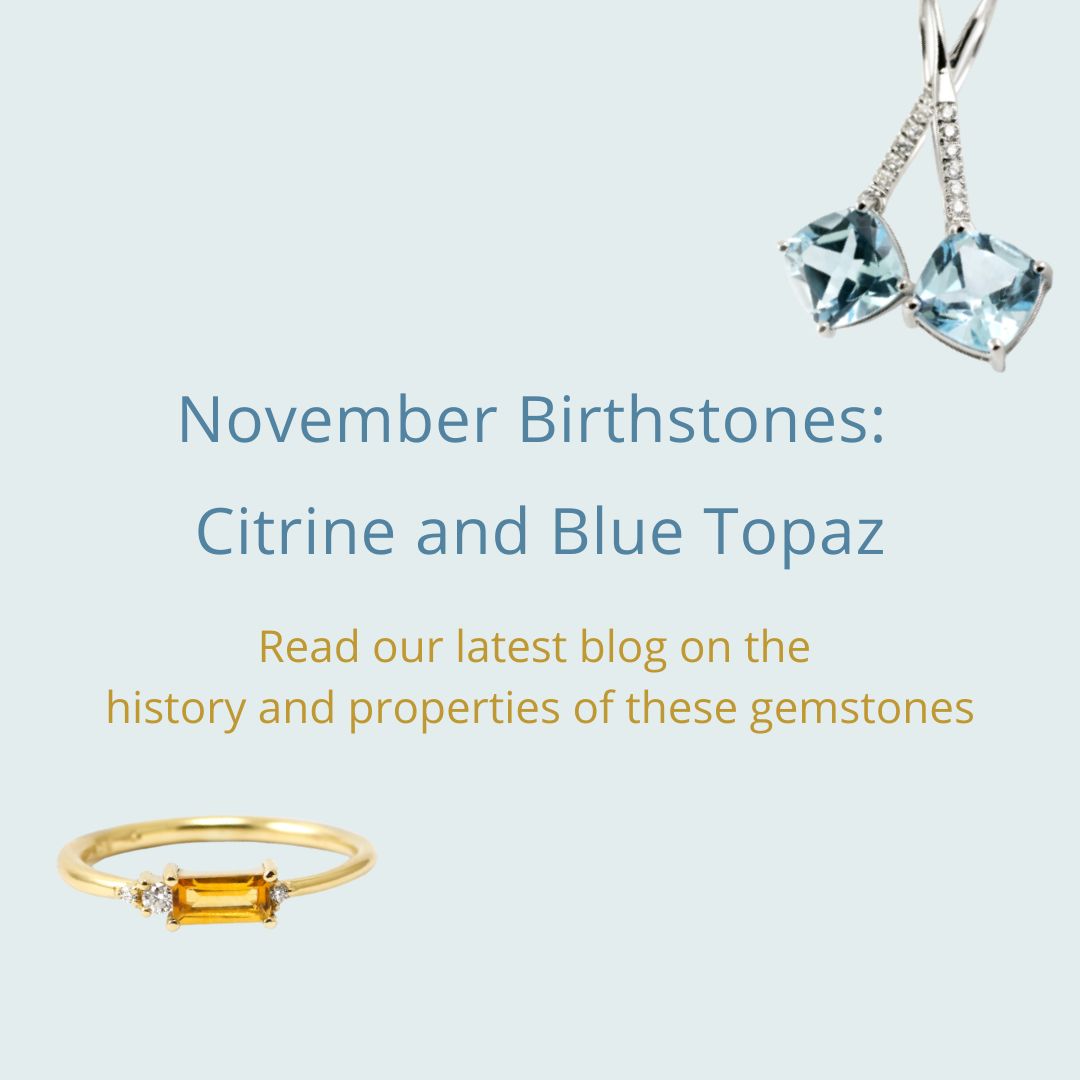
The Birthstone for November is Blue Topaz or Citrine

Did you know that Blue Topaz is extremely rare? It is said to believe that topaz portray healing and peace properties. The gemstone was founded by Romans over two millennia ago on an island in the Red sea. The Romans believed it would protect them from evil and their enemies. During the gold rush of the 18th century, the Brazilian topaz became very popular amongst European aristocracy. The famous exquisite Braganza topaz is set in the Portuguese Royal crown. Colour Topaz is a silicate mineral of fluorine and aluminium. Interestingly blue Topaz is more rare and therefore needs to be heated and irradiated to obtain its colour. However, the heat treatment or irradiation is permanent and it won’t discolour after time. Blue Topaz can range from light blue to deep ocean blue. It also presents a slightly turquoise hue that resembles aquamarine. Due to the rarity of the topaz, it is important to treat this gemstone with the utmost care. We will be sharing some clean & caring tips with you too. Care and Cleaning Topaz is a natural crystal and therefore can be brittle if knocked or exposed to sudden change of temperature. It is recommended to use warm water and soap, use a cloth or soft toothbrush to clean your stone. Gently pat your topaz dry afterwards and it will be as good as new. Planning your Christmas shopping Can you believe we are approaching November already?!  Now is the perfect time to start prepping for all your Christmas gifts. Spoil your special person with a divine item of Blue Topaz jewellery. These stones are perfect gifts for your 4th, 13th or 17th wedding anniversary as well. We also have gift vouchers that can be added or given as a gift for your loved ones to choose their own preferred item of jewellery. If you need any more convincing, the Blue Topaz appears in a variety of colours yellow, grey, red and colourless pale blue and pink.  What about Citrine? Is an alternative birthstone for the month of November. It is known as the 13th anniversary gift. Citrine pairs perfectly with tourmaline, peridot or aquamarine. Moreso, it was wildly popular in the 1940s for its retro style. Colour The citrine gemstone has a beautiful golden glow to it. For many years people have treasured it as the gift from the sun. The name is derived from the french  word citron, or lemon. The colour ranges from a light yellow to deep honey like yellows and browns. It is the perfect pop of colour to any outfit. Meaning Citrine has healing properties associated with it. Previously the warm colours evoked a sense of warmth, sun and illumination. The gemstone resembles romance, positivity, and happiness. Recently it has become the gemstone of vitality, freshness, new beginnings, mental clarity, and emotional well-being.  None of us can deny that these last two years have been a roller coaster of emotions. We need to protect our emotional well-being daily.  What a spectacular gift it would be? Care & Clean Citrine is not as brittle as topaz and is more durable. Although it is more durable it should avoid excessive exposure to high heat. To keep your gemstone clean try not wearing it whilst applying lotion or cleaning products.  Clean with a mild dish soap in water with a soft brush behind the stone to remove any dust and greasiness. There are many more interesting facts about these 2 gemstones, which we will be sharing throughout the month on our social media platforms. Stay tuned for this month’s content and follow us on Instagram or Facebook.  We have both of these gorgeous birthstones available for you to view in our store. We would love for you to come visit and see our collections or have something made especially just for you with our collection of loose stones on display.  Stay Beautiful, Jackie Hahn & Penchant Design Team
Read More »

The birthstone for October is either a Tourmaline or an Opal

Did you know Tourmalines come in nearly every colour? Can you believe it is October already!? A new month presents a new opportunity to share insights into the history and meaning of all the gorgeous gemstones. The name “tourmaline” comes from the Sinhalese words tura mali, which mean “stone of mixed colors.” Starting with Tourmalines that come in an array of beautiful and vibrant colours. From the deepest of blues and greens to the lightest of pinks and yellow, this stone comes in nearly every colour. A certain species of tourmaline, called schorl, can even come in black or dark brown. It’s thanks to this amazing colouration that this stone has earned the title of the ‘Rainbow Gemstone’. This gemstone happens to be one of my favourites for this very reason. What is so unique about a Tournamline?  One of the reasons are that a Tourmaline  is  pleochroic,  which  means  you  can  see  different  colours  when  viewed  from  different  angles. In addition, you also get Bi-coloured Tourmalines as the crystals may be green on one end and pink on the other.  The second reason is because a Tournamline can be as clear as a diamond! The only thing better than a wide variety of stunning colours is a colourful stone that allows light to pass through, creating a majestic effect that will leave onlookers in awe.  Opal, the alternative birthstone for the month of October  Along with tourmalines, Opal is the birthstone for the month of October too. It is also the stone given to celebrate the 14th year of marriage. The name Opal is thought to be derived from the Sanskrit upala, meaning “precious stone,” and later the Greek derivative “Opallios,” meaning “to see a change of colour.” How did the Opal stone form? Opal formed millions of years ago when heavy rains soaked the sun-baked ground in the arid desert, and rainwater carried a dissolved mineral called silica into cracks inside rocks. When the water dried, the silica deposits were left, and these layers formed Opal. Do Opals come in many colours? Yes, they do and each Opal reflects light differently therefore no two Opals are exactly the same colour. However, you get mainly 3 colour types.  White Opal is the most popular type in jewellery because it’s pearly white colour is easy to wear and combine with any outfit. It can be milky, translucent or opaque, and it shows a stunning, pastel-shaded play of colour when you move it in the light. Fire Opal on the other hand comes in translucent orange, yellow or red hues. It is sometimes called Mexican Opal. Black Opal is the rarest type of Opal. Its background is very dark and because of this its play of colour really stands out. However, its price can be prohibitive and its dark colour is hard to wear; that’s why it is usually reserved for big, expensive statement jewellery pieces. There are many more interesting facts about these 2 gemstones, which we will be sharing throughout the month on our social media platforms. Stay tuned for this month’s content and follow us on Instagram or Facebook.  We have both of these gorgeous birthstones available for you to view in our store. We would love for you to come visit and see our collections.  Stay Beautiful, Jackie Hahn & Penchant Design Team  

Read More »